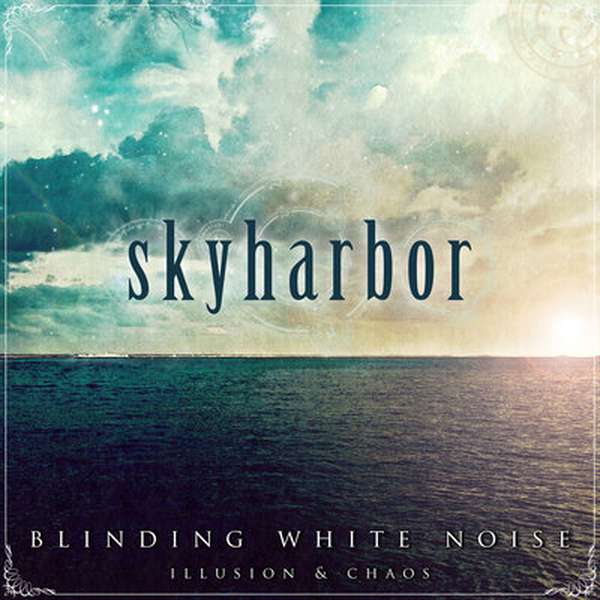
There aren't many ways that I can describe the emotions I get from Indian djentlemen Skyharbor's debut album, and part of the reason is that the cumbersomely titled Blinding White Noise: Illusion & Chaos brings with it some incredibly polarizing feelings. On the one hand, it's one of the most pleasurable aural experiences I've had the pleasure to receive. On the other, the music itself really doesn't have a lot of meat to it, something I find invaluable for repeated listening, leaving a noticeable feeling of dissatisfaction. So how does the album pan out overall?
The first and foremost issue I have with this album is that Skyharbor really aren't bringing anything new to the table here. I know I've made this complaint many times about bands of the genre before (read: every single time I have to mention djent), but let's face it: few bands are actually stepping outside the box, and Skyharbor are no exception. Their aesthetic parallels almost exactly that of Tesseract down to a t, and Tesseract is a band I'd already describe as "formulaic" for the genre. Let me put it this way: on their own, the mix of clean vocals and screaming, the comparatively simplistic rhythmic work, and the heavy focus on non-challenging melodicism are all valid songwriting elements that can be used to great effect. Their combination, however, is far from original territory, and has been pracitised by so many bands before that standing out amongst them is almost a fruitless effort from the beginning. Regardless of the fact that Skyharbor's performance here is unarguably top-notch, the sheer distance they need to go to get away from their peers in order to actually stand out in this oversaturated genre is immense, and they don't seem to be able to cover it.
Of all of the elements I mentioned, it's probably the lack of true rhyhtmic flair that really does them in. Given that polyrhythmic writing is baseline for djent music, anything that doesn't have the listener getting out staff paper to map it out is going to sound like it's been done before. There are only so many basic syncopated rhyhthms that can be played without repeating a few core ideas, and unfortunately, Skyharbor's unwillingness to really challenge themselves in this area becomes the key factor behind their generic sound. Though there are some interesting moments here and there, especially on the more technical later pieces like "Trayus" and "Aphasia", they tend to be the exception rather than the rule. The machine-gun riffing on "Dots", while interesting, is incredibly predictable, and the syncopated riffs on "Maeva" tend to take the path of least resistance towards resolution rather than remaining as challenging as they could've been.
In many ways, this album sounds as if it is just a big damn hard rock album that merely uses the djent aesthetic as backdrop for its core ideas (and that's not meant to be taken as insulting, by the by). Images of Devin Townsend's Ocean Machine: Biomech spring to mind, mostly stemming from the almost larger-than-life, sweeping melodic compositions used to convey what are, at heart, very simple ideas. There are also hints at Cloudkicker's The Discovery, what with the densely composed wall-of-sound moments that tend to leave you having fallen over in your chair. The solos in "Celestial" and "Catharsis", without a doubt some of the highlights of the album, are definitely rooted in a hard rock/heavy metal mentality, and pieces like "Aurora" and "Night" definitely betray the kind of gratifying melodicism that's a trademark of the genre. On an (unfortunately) related note, the lyrics aren't particularly interesting, tending to be more on the predictable, if not entirely formulaic, end of the spectrum. They fit the music well enough with their almost disarming simplicity, but they leave so much potential undeveloped that it's disappointing.
Okay, after re-reading all of that, I think I need to clarify something: all of that said, I still really (really!) do like this album. It creates this intensely pleasurable aural experience of floating somewhere above an endless expanse of ocean, somewhere slightly above the cloud layer, looking up at the infinite expanse of space above you, pondering nothing but the cool breeze and occasional trickle of rain on your face, all happening in 5/4 time. Few albums, if any, ever get me into that kind of serious adjective-laden description porn. The important point I'm trying to get at is that the technical deficiencies of this otherwise incredibly enjoyable album really do hamper it and prevent it from being a truly great and standout release.
This isn't exactly relevant to the music, but the fact that it's a double album with a runtime of only 48 minutes is kind of irksome. I get the idea of separating major musical ideas from each other even if the physical space of two CDs is not necessary--Porcupine Tree's The Incident springs to mind as a good example. But the two halves of this album, Illusion and Chaos, don't seem sufficiently dissimilar to warrant the break. The former does seem more straightforwardly melodic whereas the latter does seem a bit more thrashy and death-oriented, but the difference is a fine, unpronounced one. It's a technical complaint, I'm aware, but it's still relevant to the enjoyment of the physical album.
Seen as a band that's simply trying to express and refine within the established genre rather than breaking outside of it, Skyharbor have succeed handily--Blinding White Noise is something of a refinement of all of the bands that have come before them, taking a preexisting formula and perfecting it as much as possible without leaving its bounds. However, they aren't the only band embarking on this project, and their inability to truly push their own musical ability into uncharted territory means they more or less blend in with the crowd. While it's not completely homogenous (the song "Celestial" alone is almost worth the price of admission), it's not terribly standout as a whole, either. You will definitely enjoy this album, but there isn't a lot to it that will surprise you.