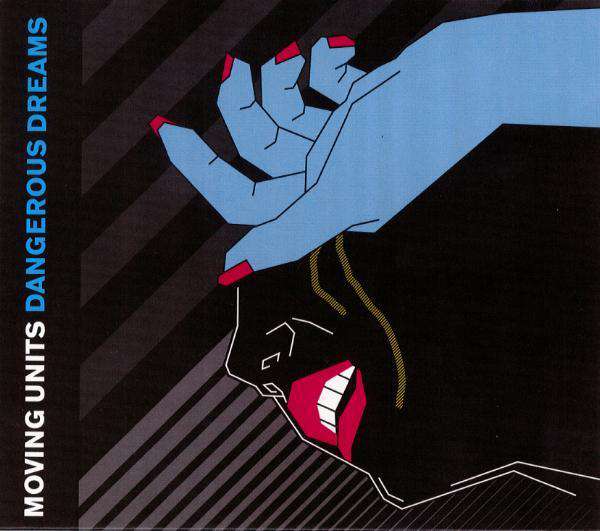
Moving Units played at last year's Sunset Junction Street Fair, which had an impressive line-up of indie pop and rock bands, including Guided by Voices, Rilo Kiley, and Earlimart. I groaned when I first heard Moving Units' debut Dangerous Dreams, because I anticipated an indie pop or rock band instead of a dance punk band; dance punk, or whatever you want to call it, is not my cup of tea. Although Blake Miller's vocals are not as whiny and irritating as Luke Jenner's of the Rapture, the music is extremely repetitive. Moving Units' songs range from as short as two minutes to as long as five minutes and some odd seconds, but even the shorter songs seem as lengthy and tedious as the longer ones.
The riff in the beginning of "Emancipation" is fairly misleading, because it sounds like any other punk song; Miller chants "yeah, yeah," initiating the staccato guitar strumming and bouncy bass line. The bass lines on this record are the only interesting and constant driving force, since the lyrics and melodies are nauseatingly repetitive, especially in "Emancipation" and "Available." "Between Us & Them" is the best song on the album. Miller's vocals actually compete for attention with the bass, while the drums and guitar provide the appropriate support. There is variability in the lyrics and each transition in the song is smooth.
Moving Units approach a different sound in "Scars," with the atmospheric guitar; the sound is closer to Interpol and the Yeah Yeah Yeahs than Radio 4 and the Rapture. At almost six minutes in length, it would still be a complete song if half of the song was cut out. "Killer/Lover" is the shortest song, but it appears to drag on almost as long as "Scars." The abrasive guitar creates tension that is lost in the rhythmless section where Miller ironically sings "there's no feeling/there's no meaning." However, the most disappointing track on the album is the last track, "Turn Away." It's the band's last chance to create some sort of an impression, but they bomb it. The drums are left out completely and the tempo is inappropriate, too slow to do any sort of dancing to. Miller builds up intensity with his wailing, but the band never provides the appropriate release as the song fades out to conclude the album.
Bands like !!! and the Faint prove that dance punk can be enjoyable, while Moving Units simply sully the reputation. Moving Units need to have more variability within their songs to achieve a higher level of mediocrity.