With the passing of Lance Hahn, the fragile punk continuum lost one of its all-time greats. Smart, critical, and relentlessly prolific, Hahn's work provided a formidable example of what could be accomplished in DIY music: punk not as a costume contest or stale doctrine, but a design for living. Hahn refused to separate his art and his life, delivering record after record like he was ripping pages from his diary, tossing them over his shoulder as he circled the earth (both figuratively and literally).
And it didn't hurt that he was first-rate songwriter, with a much higher batting average than most artists who make a virtue out of being prolific. J Church played an almost constant presence in stores, venues and mail-order catalogs for the last fifteen years, making his death even more of a shock. Some of us took it for granted that he'd always be there, cranking out beautiful songs about loneliness and alienation, broken hearts and broken windows, some hope and some despair.
Because the end of his life came through a cruel twist of fate rather than any kind of personal choice, Hahn's final LP doesn't sound like a last will and testament, but an interrupted conversation - a conversation that's been going on since 1992, when Hahn and Gardner Maxam dissolved Cringer to form J Church. The topics have oscillated wildly in that time: we've laughed as Hahn ranted about Guitar Center's theater of the absurd, listened intently as he laid out his defense of Bikini Kill, and nodded solemnly at his condemnation of Nazi propagandess Leni Riefenstahl.
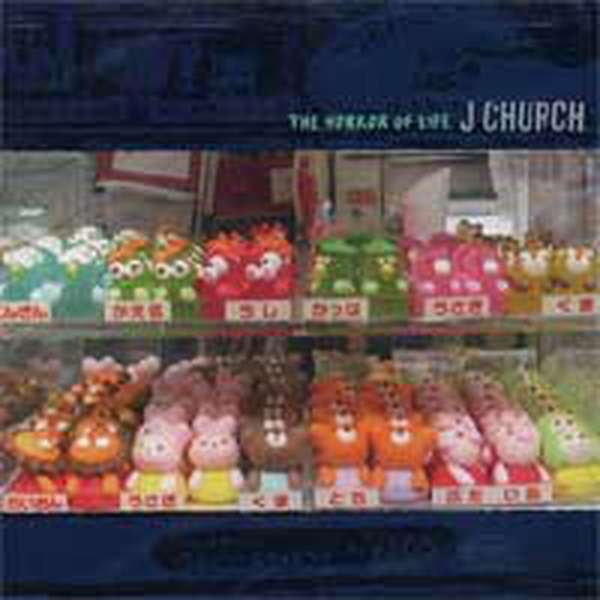
And even a cursory glance over The Horror of Life's titles reveals a set of songs as cultured as ever, with references that encompass the anarchist Emma Goldman, free jazz hornblower Eric Dolphy, French New Wave and short story savant Raymond Carver. Sonically, The Horror of Life is part and parcel of the late stage of the J Church conversation; I once heard Hahn call it the band's "hardcore renaissance." After relocating to Austin, TX, J Church re-staffed to include Severed Head of State drummer Chris Pfeffer - elegantly credited on that band's records as "The Hammer" - and began to play faster and harder than the band had in
well, maybe ever.
But The Horror of Life isn't really a hardcore album, despite the fact that Hahn nearly strains his voice into a roar on songs like "Eric Dolphy" and the scathing "If I Have to Dance Then I Don't Want Your Revolution." The latter is especially striking: it's the most bitter J Church song in ages, an acidic broadside that seems like it could've been co-written by Naomi Klein ("The revolutionary ideals, they're happy to steal / And turn into gimmicks for postmodern cynics"). But underneath the album's energized fury is the same shimmering songcraft and fragile humanity that have always made J Church something more than another punk band; even the d-beats(!) on "Bande à Part" can't hide these qualities.
Still, The Horror of Life sounds like a protest record, and it reads like one too. For some reason, a vast middle swath of the album's songs are absent from the lyric sheet, but what remains is revelatory enough. This is J Church, so there are none of the tired antiwar platitudes that so many mainstream artists have used to re-brand themselves. Instead, Hahn offers the same anti-capital ire he's cornered the market on (pun not intended) since the early '90s, when class analysis was hopelessly out of vogue. And it sounds timelier than ever, now that we've realized how all our debates over images and representation only let late capitalism strengthen its stranglehold over us. On the second side, some of the sociology melts into air as Hahn swings back toward the personal - but that's always been the nature of the beast with J Church.
As crestfallen as I am over Hahn's death, I can't deny that The Horror of Life isn't the best J Church record I've ever heard. It's not as dazzling as One Mississippi's widescreen glow, or as perfectly pitched as Arbor Vitae's tightly-wound L.A. stories. But it's a great album nonetheless, and another small masterpiece from a band who quietly created them for fifteen years, weathering countless punk rock fads and watching lesser bands rise and fall.
As I said before, it doesn't feel like goodbye - it feels like the interruption that it is. And the silence is deafening.