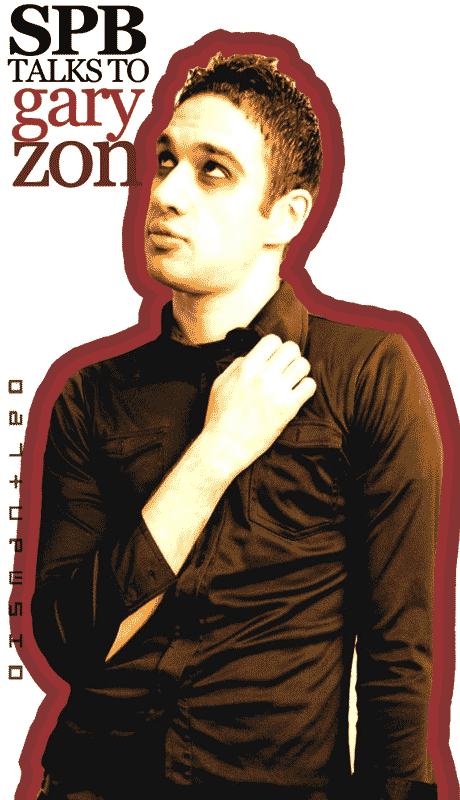
Scene Point Blank: Hey Gary. Thanks for taking the time to talk to Scene Point Blank. How the devil are you?
Gary Zon: Comfortably numb.
Scene Point Blank: You've just finished recording your new album, Standard Issue. How do you feel you've moved on, personally and musically between the new album and PostNuclear?
Gary Zon: I've actually had Standard Issue in mind and roughly in demo form on my computer right after I finished the debut album but realized that that vision will have to wait until I got something else out of my system and that was PostNuclear. PostNuclear was my reaction to college. Quite simply, when I got signed I noticed I got worse and worse at school activities and college was a big gray phase for me where I was a complete loner and failed classes. That's a pretty bad combination because it's usually you have a social aspect at school if you're not doing great academically but I had neither. I just flat out failed and that really brought me down. I remember conjuring up songs for the albums while I was failing math test and blasting Nine Inch Nails and feeling that the only way I could do anything about my situation there is write PostNuclear.
The end of that album, however, says "And what they say is that I've got to change, so I think I'll go and do that right now." And that precisely explains the change in direction with Standard Issue. I just realized I have to be like everyone else in order to feel normal about myself both personally and musically and that's exactly what I did. I put out an album with all the elements that I feel are popular right now and started wearing tight pants so I could be like all the indie rock band guys out there, even thought I'm just an industrial band with an indie rock side project. And to me that was consciously such a stupid thing to do but I realized that if you can't beat them, join them. And surprisingly, doing that made me feel way better about myself and I got a lot of chicks in the process. Even though that meant dropping out of college after four years, a 2.5 GPA and an academic warning. I think the only classes I ever enjoyed were this film class and a music business class and that's it.
Scene Point Blank: Standard Issue is, "a sarcastic take on the simplicity and emptiness of the current musical climate." Care to expand?
Gary Zon: I listened to the popular stuff out on Metro and Dependent and to me it's all recycled, simple beats with no message behind them. Just generic dance fodder. I remember on tour they'd always play this incredibly stupid song in every club we performed at and it was something about marching like the marines and had all those annoying army samples. Man, that song was the shit! Everyone would be into it and I thought, "If this is the kind of crap I'm competing with then I might as well just make fun of it."
Scene Point Blank: In this sarcasm, it seems that your music itself is becoming more simple and repetitive itself. Given that the "irony", for lack of a better word, of this is that the people it is aimed at may never get that sarcasm. Can you forgive me for asking, what's the point, when the statement will be missed by most, and was never necessary for those who will get it?
Gary Zon: I personally think that the music has a point in being the way it is because its still extremely catchy and accessible while having a deeper quality than most of what sounds like it. Combined with the lyrics, I think it makes quite an impression on people intelligent enough to look into it. But it's even better for those that don't get because one of the things that I will look forward to is being at a packed club with "Get It Through" pounding on the speakers and watching everyone dance to it while being completely oblivious to the lyrics. That to me will be a very special spectacle because I will be the only one that gets the joke and that's really all that matters to me. I remember one of the first things my label guy in Germany told me is that no one pays attention to the lyrics and it's all about the beat that matters. Well, I'm glad I'm taking that advice to heart!
Scene Point Blank: Correct me if I'm wrong, but you seemed somewhat upset about the lack of exposure Metropolis gave you around the release of PostNuclear. Given that, what was with the decision to stay on the label this time around?
Gary Zon: The whole point of being at the label at that point was the whole "if you can't beat them, join them" attitude. I decided to give the label exactly what they wanted and to try to prove to everyone that I can be successful doing that while still making fun of the fact that I have to do that. But honestly, I don't think Metro is a bad label at all for the type of music on it and it's mainly the people that decide what's popular, not the label. Metro went a long way into signing bands that were not generic sounding like my first album and Mindless Self Indulgence. I remember taking to the head of Metro and he even told me he was bored of the VNV Nation sound and wanted to try to get other bands noticed. So I do have a respect for Metropolis in that regard and hope I can have more releases on the label in the future. Even though I once was kind of kicked off for writing something on my website about my artwork being messed up but that got ironed out and I'm very glad it did.
Scene Point Blank: Your reaction towards media exposure always seems to be one of dismay from lack of attention. Can you explain why?
Gary Zon: I've always gotten good grades in high school but was unknown socially so it's kind of the same thing with Dismantled. I get great reviews and press but for all my A+ work, I still have that underground status and can't get on that forefront where I'm hip with all the kids. I guess that's what I get for trying something different. But at this point I'm really not interested in reviews or press in German magazines crowning my shit "Album of The Month" because that already happened two years ago with my first album. I've been there, done that and now it's time for something different. And "different" at this point means generic, kind of like bands that get shitty reviews for their albums but still sell tons of CDs. I've always tried to be different with Dismantled and that was great artistically but not that marketable. My mistake with my first album was not going to Europe by myself and putting on a karaoke show for everyone who doesn't know what a live show is and instead getting a full live band and waiting for a while until we were ready to play-- with a bass player, keyboardist and Front Line Assembly's drummer Adrian White. That took a long time and lots of hard work that paid off for me in expressing exactly what I wanted but didn't really fit into what the rest of the scene was doing. I remember playing in Chicago in between God Module and Cenobita and people were like "What the fuck is this? It's great but I can't fit this anywhere!" I guess I'd do better in the early nineties with my attitude.
Scene Point Blank: Do you feel, in any way, that expecting a particular level of media interest, given how comparatively un-commercial the music you make with Dismantled is, is asking a bit too much of the media, and people in general?
Gary Zon: I definitely agree with that statement but there's way too many people who come up to me and tell me how popular Dismantled could be if it wasn't on an industrial label and promoted differently. This was happening ever since I released PostNuclear and somehow I was tricked into believing this was true and I did have potential. It's too bad that I'm not pushy or motivated enough to sell myself to other labels or convince people that I work, but I'd imagine it'd be kind of hard anyway with a catch phrase like "Breed To Death." So I'm completely confused about the commercial potency of the band at this point and hope that by releasing something that sounds like everything else out there will somehow make it better? Who knows.