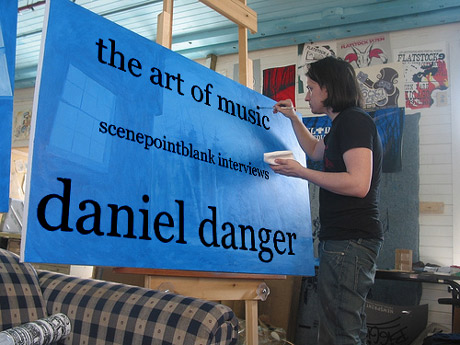
From the intricate and beautiful Led Zeppelin LPs of yesterday to some of the more forgettable album covers of the day, art and music will forever be bound in matrimony - for better or for worse. Bad album artwork can bring down a good release, and can make a bad release that much worse. Likewise, it is usually the case that the best music of today is accompanied by a truly amazing piece of artwork. Daniel Danger is one of the artists creating that artwork, producing some of the more memorable artwork for today's musicians. Daniel talked with Scene Point Blank, discussing controversy, crazy boxers, and the role art takes in the aesthetics of music today.
Scene Point Blank: So Daniel Danger, huh? How did that name come about?
Daniel Danger: Well, I was 14 and in a terrible junior high punk band who worshiped the Queers, we did that thing where we made our last name the band name. Accordingly, our band name was The Dangerouslys, named after the Michael Keaton movie Johnny Dangerously, so I became Daniel Dangerously. It just sort of stuck because nobody could pronounce my real name, which is crazy and Polish and has a silent j in it. Nobody could remember it or spell it. People would be like ?Well who did you have in mind for the artwork?? ?Well, there?s Daniel Nieasdaflfsdgidfkdsfk, he?s pretty good.?
Scene Point Blank: When did you know you wanted to be an artist, and what was your inspiration to do so?
Daniel Danger: I know its cliche to say ?I?ve been drawing since I was old enough to hold a crayon,? but it was true. It just sort of came naturally and I grew up in a household that was absurdly supportive of the arts. My father was an art teacher and photographer, and my mother does pottery professionally and a variety of other things. They both taught offset printing at a local high school on the actual Heidelberg press I now have in my studio, which I bought from the school with the other Tinymedia folk. So I grew up spending my weekends at art fairs and surrounded by people who made their living selling their own work, and well, here I am. Natural progression of things I suppose. Plus, I sucked at math.
Scene Point Blank: You're self-employed and run your own small business. What are the pros and cons in being self-employed when working with music and art?
Daniel Danger: Well, you know that guy at your work who comes in every day late, dicks off for an hour before doing his one hour of actual work, and then always has a dental appointment or a dog show or something and has to leave early? The hardest part of being self employed is being incredibly aware when you?re being that guy and you?re also the one writing that guy?s check. The biggest con is that everything is on you, every mistake, every late order, every missed deadline, every email you forgot to answer, it all comes back to haunt you at the end of the day if you don?t take care of it. And once things started really picking up, those responsibilities came knocking harder and faster. You can?t pawn anything off on Larry in accounting. The pros simply being that I can do things at my own pace, make my own hours, get up and leave for a week to travel, or for a month to tour, that I don?t have to call out of work if I want to attend my own art show. things of that nature. Plus, I like working from my couch some days. It?s nice to support yourself solely by yourself, and enjoy doing it.
Scene Point Blank: Speaking of which, you run your website Tiny Media Empire with a partner, Stephen Swift. How did this partnership come about?
Daniel Danger: Seventh grade science class, I think. Swift is a great punch-up guy for what I do, and I?m a great catalyst for him to do what he does. Most of our projects somehow end up involving each other anyways. We wanted to create an umbrella site for all our various doings. He doesn?t pop up a ton, but he?s around. He?s working currently on a comic at millionsofbees.com with this fellow named Arthur. A good example of my working relationship with him is that on a road trip to DC he said he was sort of just writing the plot of the strip on a strip by strip basis, and didn?t have much of a plan yet, and accordingly was having a hard time with it. So I yelled at him and then we sat down and wrote two years worth of plot line for him to work from, because I forced him to do it, now he's busting them out. That?s pretty much the nature of our working relationship, I yell at him until he does what he?s so good at.
Scene Point Blank: You have worked for such a wide variety of artists, from Funeral Diner album artwork to Arcade Fire show flyers. What is this whole process like, I imagine the band/promoter contacts you? Is this always the case?
Daniel Danger: It always varies. For gig posters, most of the time the promoters contact me, sometimes the band?s tour/merch manager contacts me, and most of the time the band doesn?t even know about it until they approve it or it?s the night of the show and they?re handed a pile of posters. Not very glamorous, but the bands have other things to worry about. In some cases I?ve approached bands and the whole deal was laid out in 4 minutes. The Aloha Japan tour posters were basically ?Hey, do you guys want posters for those shows?? ?Yeah, that would be awesome,? while I drank an overpriced coke at a shitty club in Boston. Done deal. The simpler the better. Otherwise you have to deal with like 5 levels of people who have to approve things, and it becomes a huge nightmare. Some bands have been totally awesome to work with though, they just enjoy what I do and give me free reign. I would have killed to meet the Pogues though.
Scene Point Blank: I was fortunate to watch your latest Ghost Ship print happen step by step. For those that don't know, what is the process that goes into creating a print from start to finish?
Daniel Danger: That print in particular? Two years of headaches, false starts, lost money, and me saying, ?It's not done yet," like eight thousand times. The process for that print started off with a simple painting. I busted it out in a few days, got blue paint all over a white wall by accident, and ruined a few brushes. Then I scanned the whole thing in on a household scanner in like 10 chunks and pieced it together in photoshop, did some color correcting, some cropping, a little push and pull with dodge and burn, nothing major. So at that point, the artwork was ready for the album cover, but the print wouldn?t happen for like 2 years.
Myself and Nic Bohawk pulled like 2 weeks of all-nighters trying to crashcourse ourselves in index color separations, which is sort of like printing pixels of an image using a select pallete of colors. The problem being that screenprinting isn't an exact art, that screens move, so these printed pixels will never line up perfectly in a grid, and it?ll all look funny. So that was sort of our major problem, until one night at like 3am I had a brainstorm, that I should print all the layers like a topographical map from darkest up to light, like a mountain, on black paper; so it wouldn?t matter if a pixel was slightly out of place, because there was ink and color underneath it to fill the space. It was a total nerd victory.
So once I had my separations, I flew out to Portland, OR to print at Dieselfuel. This awesome dude Ben and I spent a whole week on it. First day we were mixing inks and doing test prints, shooting some screens, followed by 4 days of solid printing. In the downtime was a lot of goofing around, eating Chinese food, and skateboarding. You can see the whole printing process at http://www.tinymediaempire.com/ghostship/